Unified log collection
Ingest from syslog (TCP, UDP, TLS, RELP), OTLP/gRPC with per-batch acknowledgment, HTTP webhooks, Kafka, Azure Event Hub, and files. Up to 150K+ events/sec sustained on a single appliance node.
The platform
logrok unifies log management and threat detection in one self-hosted platform. Everything below runs inside your environment, with no telemetry.
Collect & route
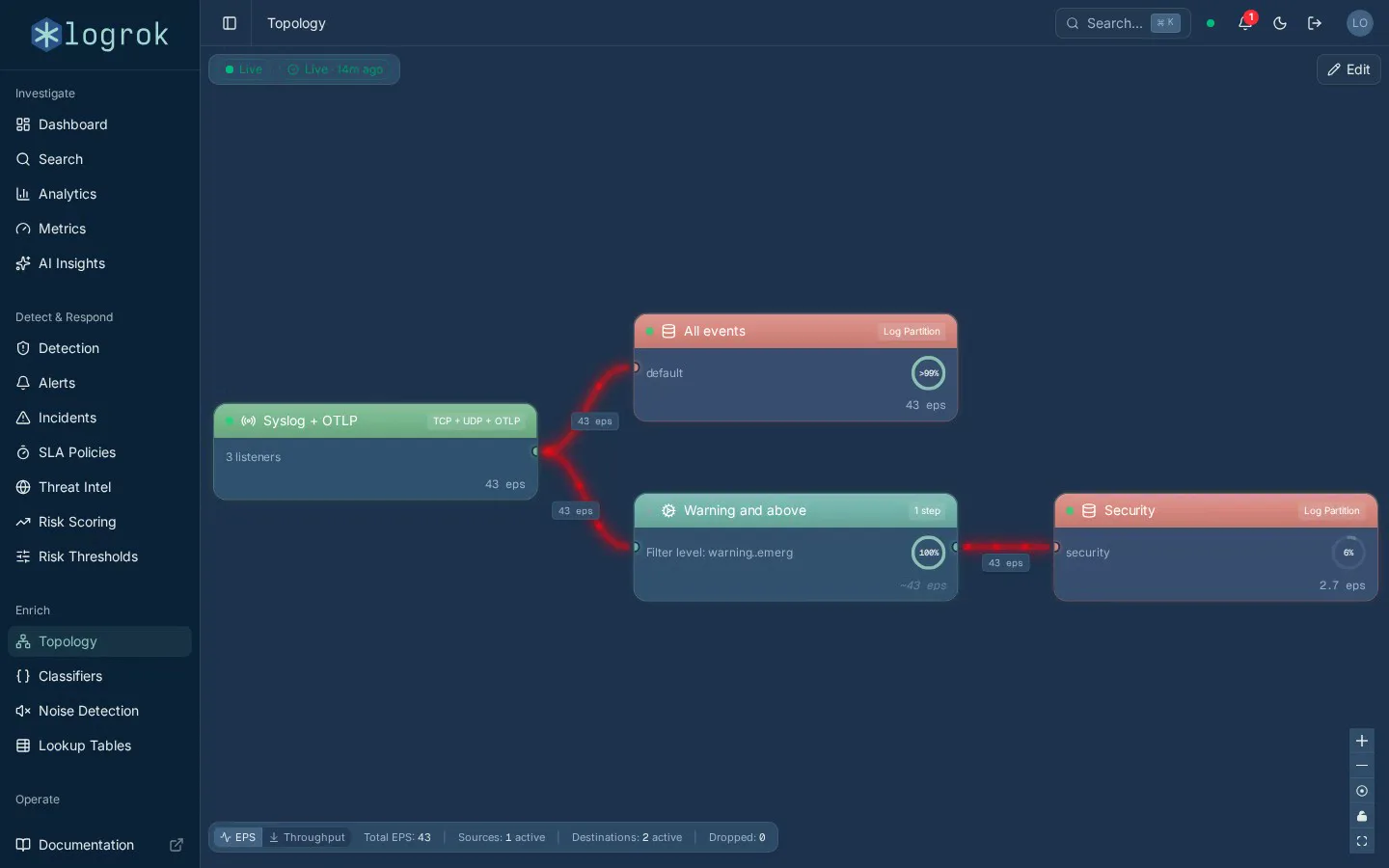
Ingest from syslog (TCP, UDP, TLS, RELP), OTLP/gRPC with per-batch acknowledgment, HTTP webhooks, Kafka, Azure Event Hub, and files. Up to 150K+ events/sec sustained on a single appliance node.
Drag-and-drop topology builder for collection pipelines. Generate (with the AI assistant), deploy, and version configs visually, with a comment and a searchable history for every change. Processors include GeoIP enrichment, classifiers, and lookup tables.
Enroll LUnA agents with one-time tokens, deliver configuration by group, upgrade agents remotely from the Agents page, deliver signed entitlements, and rotate the agent root CA without taking the fleet down. Each agent reports its license state, and a failed integrity check on its disk buffer raises a Tamper alert.
Monitor mode shows events per second or throughput on every edge, and each change goes live with a versioned, commented deploy.
Search & analyze
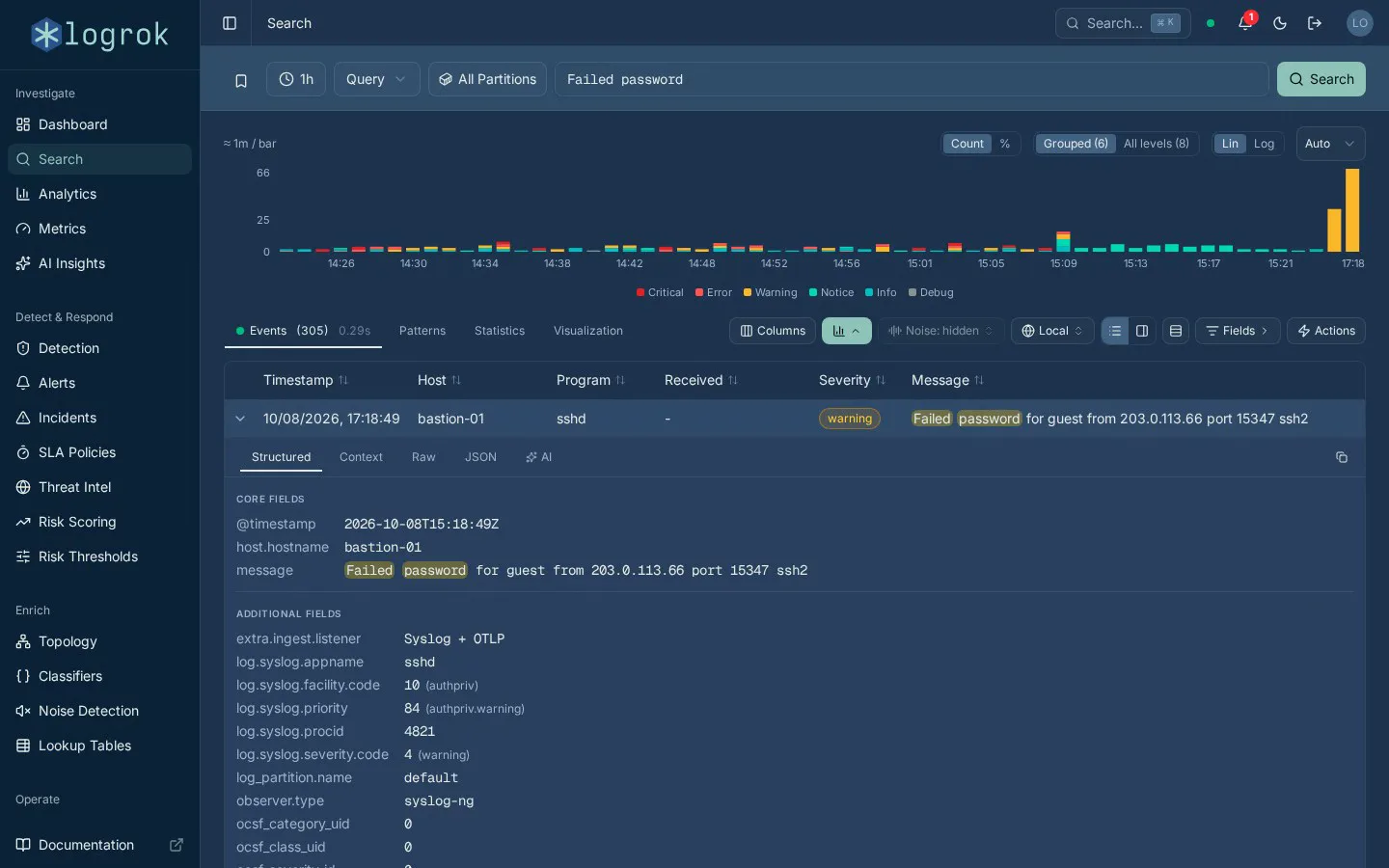
Text, regex, Query (Lucene-style field queries), SQL filter expressions (admin only), and natural-language AI search. Results load as you scroll and follow each user's log-partition permissions.
Custom dashboards with live widgets. Alert rules on patterns, thresholds, or anomalies.
Switch a result set to Patterns, Statistics or a chart; ask what stands out in a spike; save views and share them with your team; export CSV, JSON or NDJSON.
Detect & respond
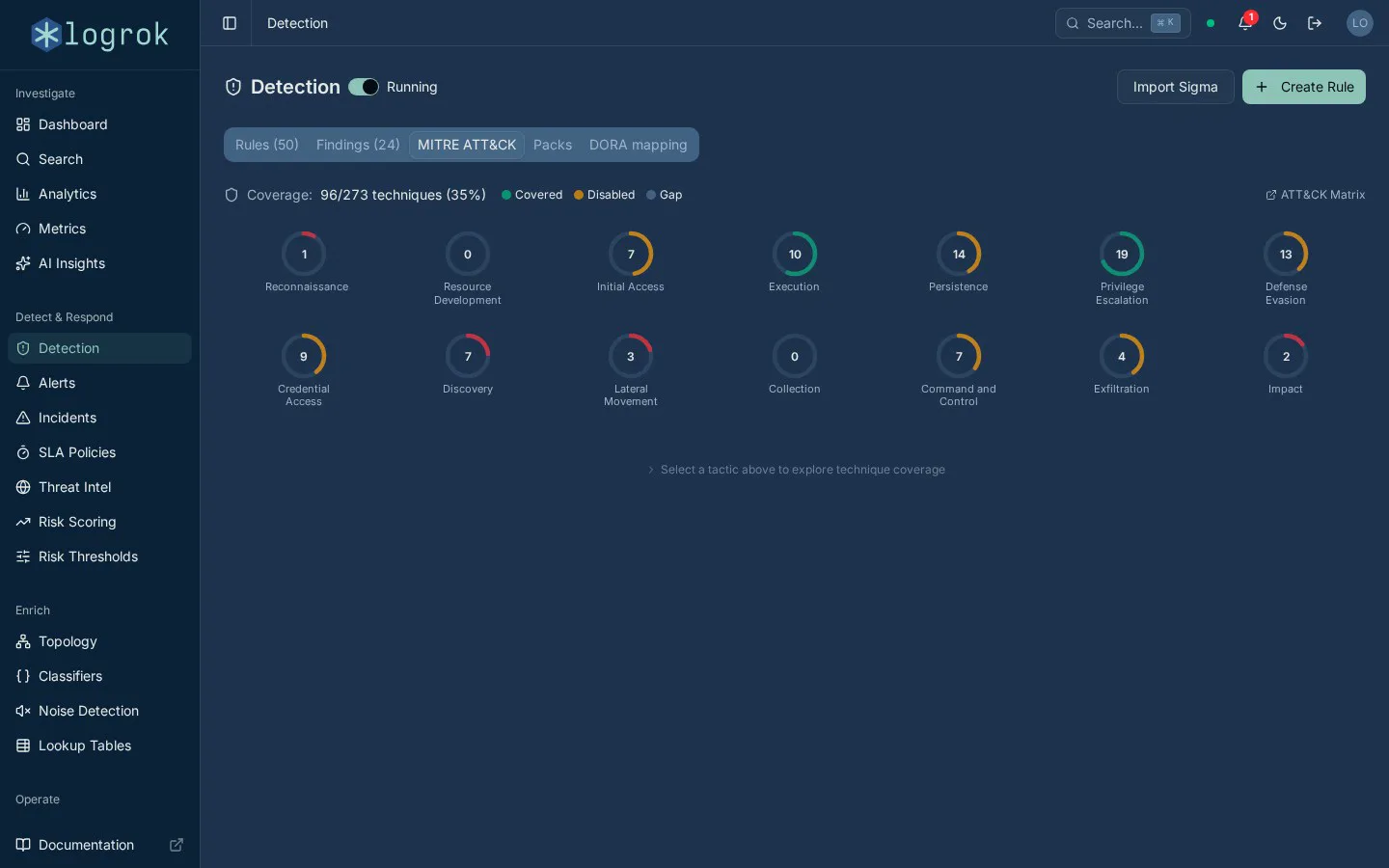
1,100+ built-in detection rules — a baseline set active out of the box and a Windows pack you activate per agent group — with MITRE ATT&CK mapping, correlation logic, and a custom rule DSL. Nine curated threat-intelligence feeds, once enabled, are matched against your logs.
Append-only, hash-chained audit log of significant platform actions, attributable per user — accountability for compliance and forensic review.
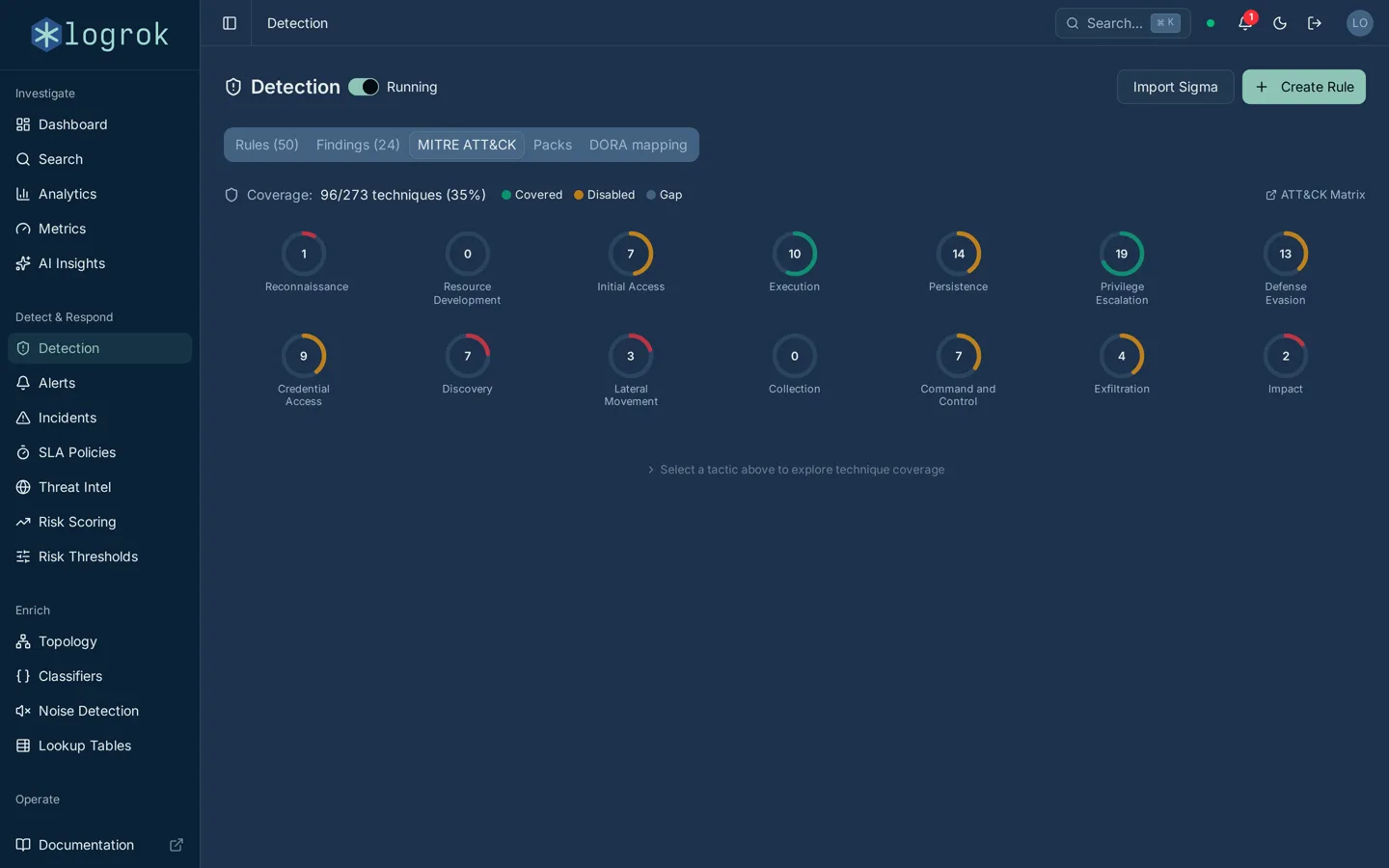
Import Sigma rules, see your technique coverage on a MITRE ATT&CK heatmap, and open each finding with its evidence and suggested investigation queries.
Reduce noise
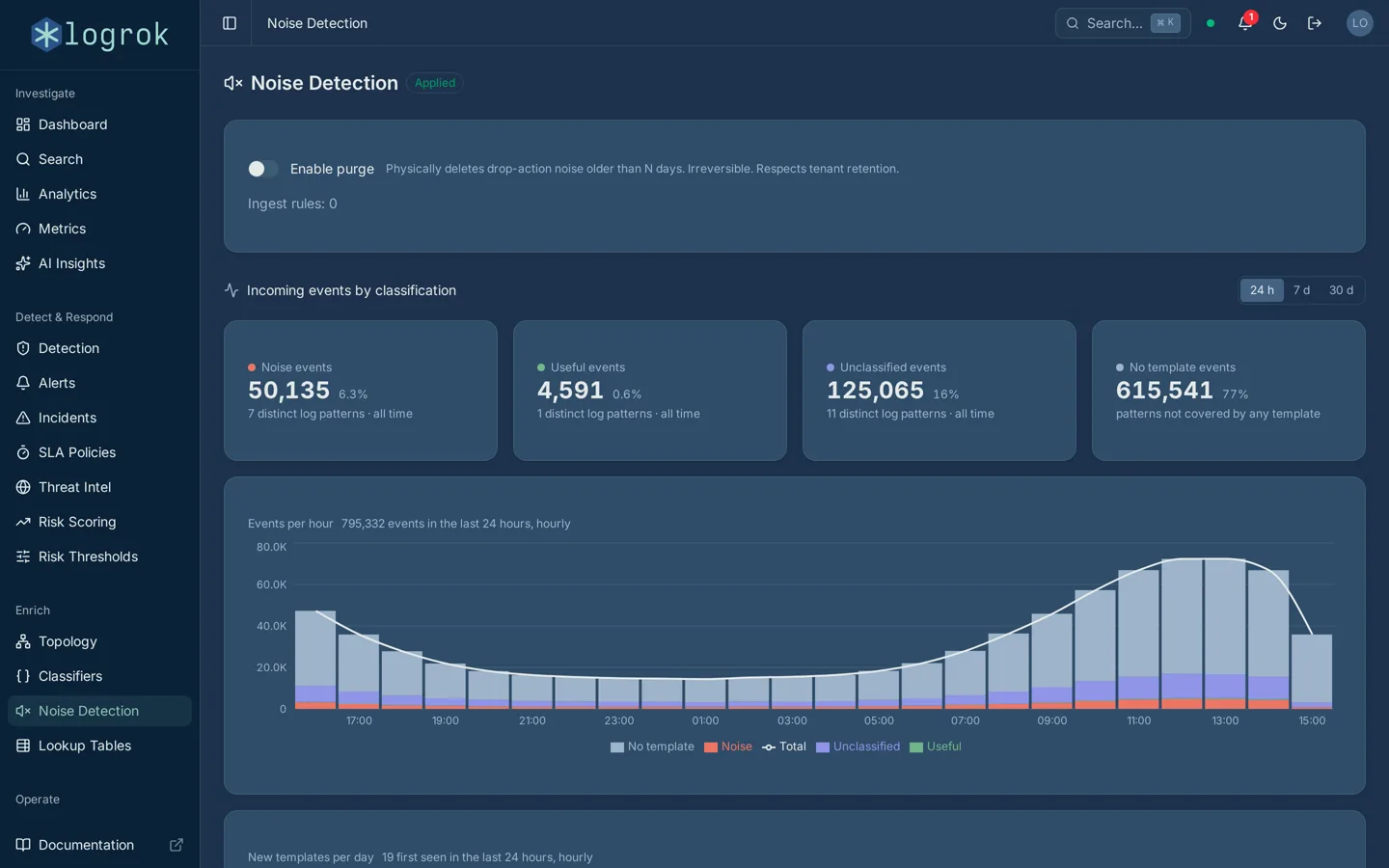
Repetitive patterns are extracted automatically and classified as noise, useful, or unclassified. For each pattern you choose to monitor, tag, route, or drop it — at ingest or at the sending host — and tag and route apply to data already stored.
Export each day's logs to S3-compatible object storage as Parquet, with a schedule, retention threshold, and credential per archive destination. Licensed rehydration replays an archived range back into a searchable logspace.
AES-256-GCM sealed-file destinations with hash-chain tamper evidence. Route to S3, Kafka, Splunk, Elasticsearch, Azure, GCP, Loki, Datadog, and more.
Prove compliance
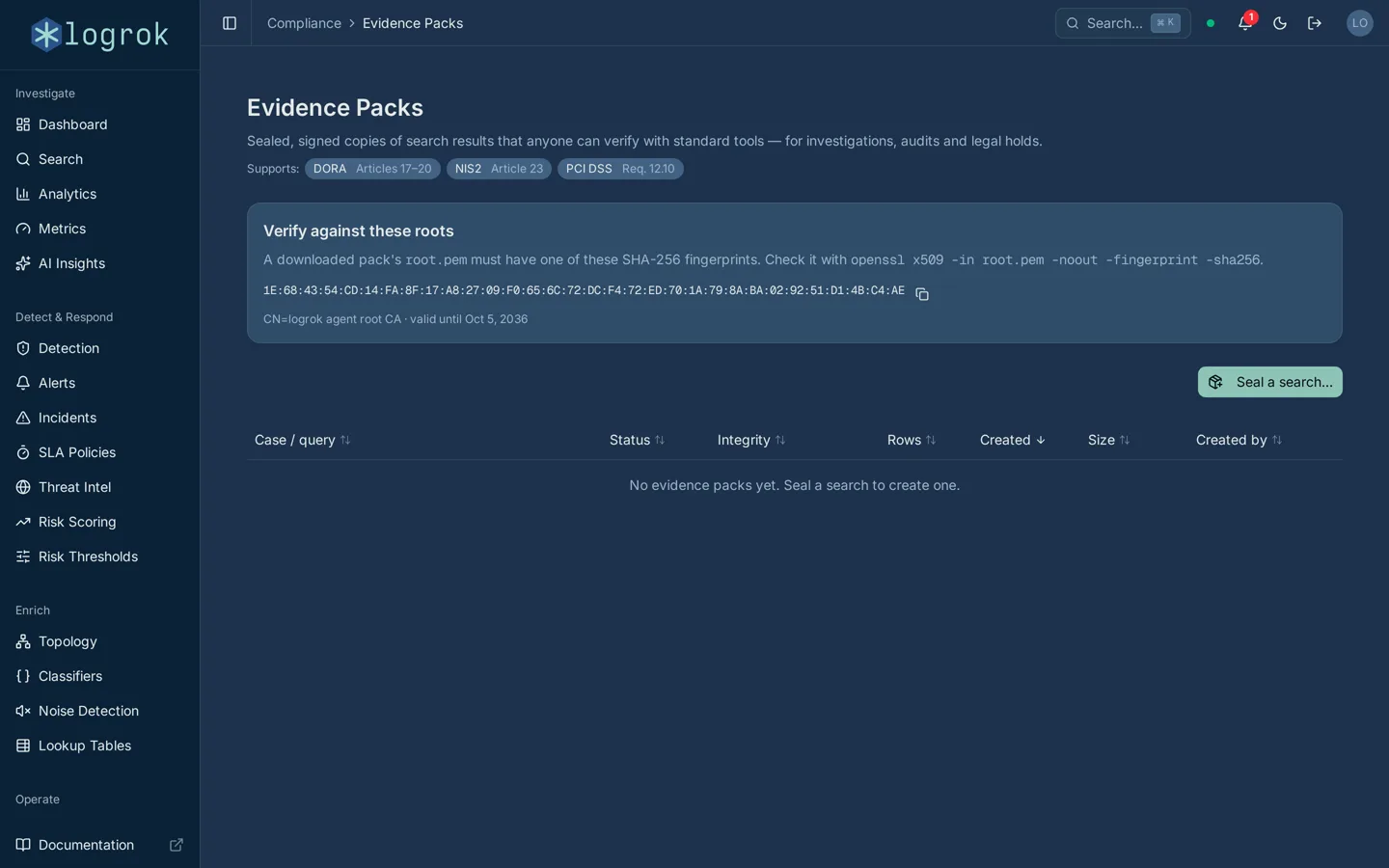
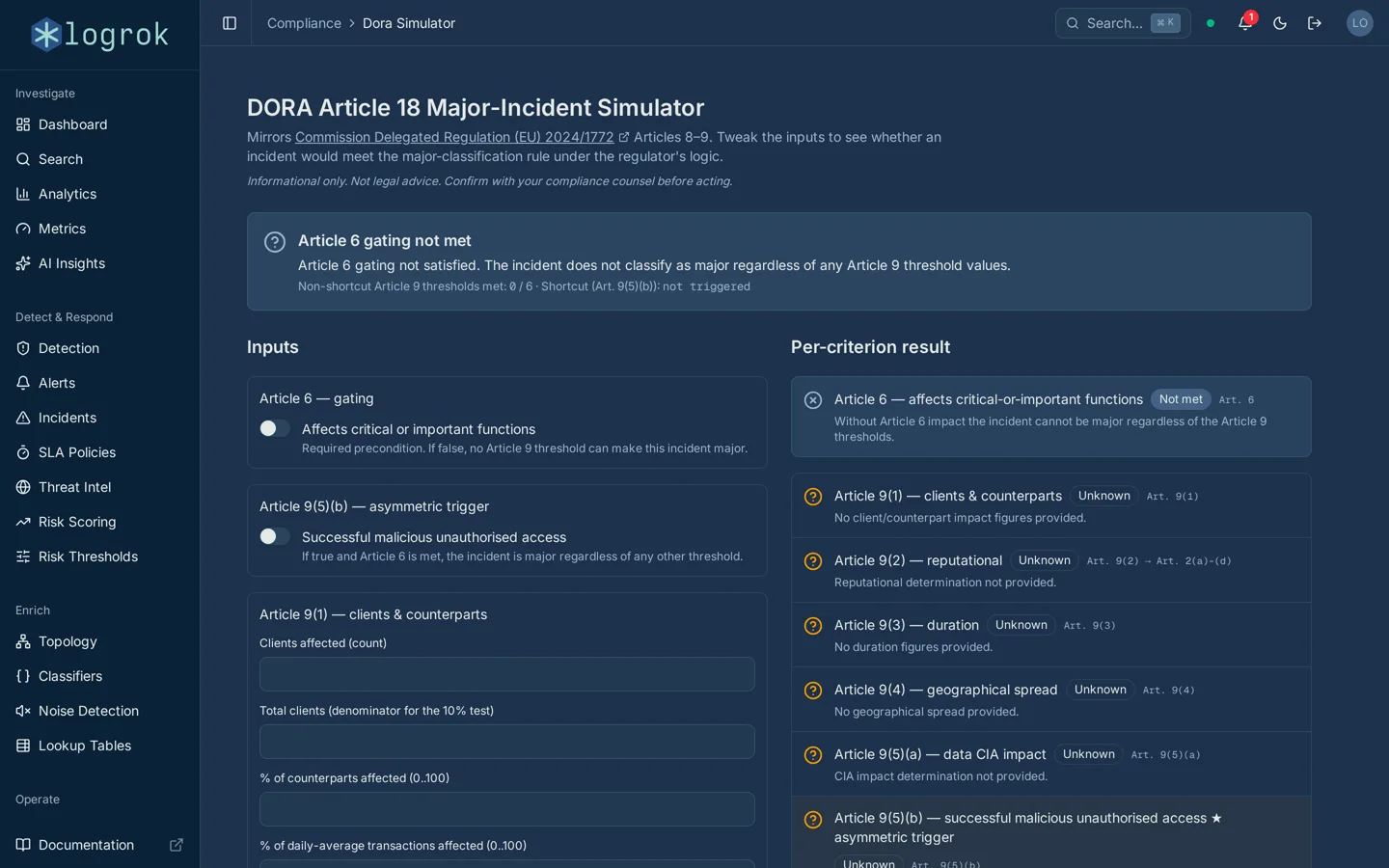
Evidence packs seal a search into a signed, encrypted archive that anyone can verify with OpenSSL, sha256sum and zstd, without logrok. Licensed DORA, NIS2 and PCI DSS packs add framework chips to a shared risk register, business-continuity and retention-posture pages; DORA adds Article 18 incident classification and a major-incident simulator, and PCI DSS a Requirement 10 evidence bundle.
SSO with MFA — FIDO2 security keys, passkeys, and CAC/PIV smart cards — and LDAP/AD, SAML 2.0, and OIDC federation. Five built-in roles, including a read-only auditor and a compliance officer, and tenant isolation enforced by database row-level security.
Events classified to OCSF v1.3 for vendor-neutral detection rules and data-lake federation.
Operate
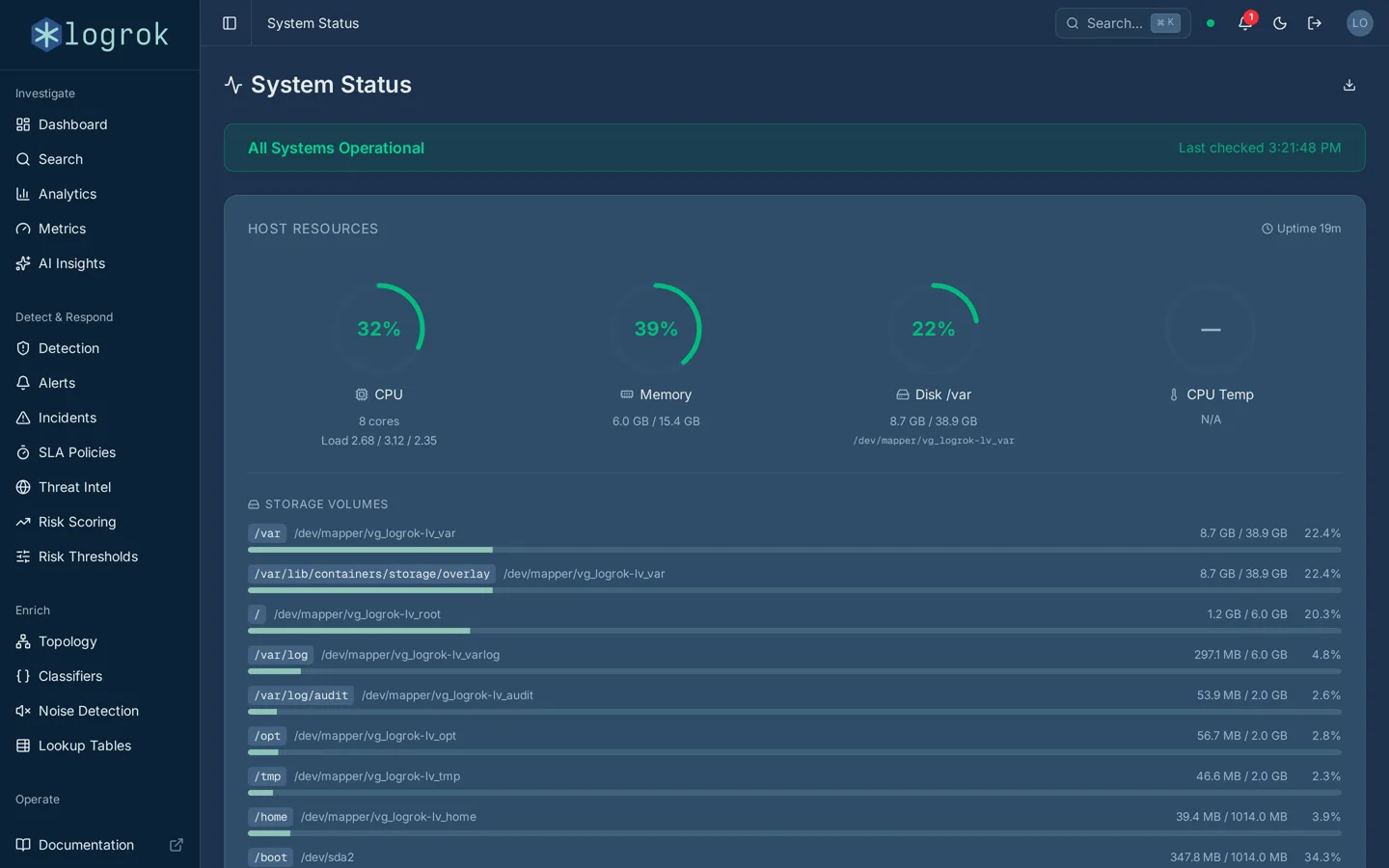
A Network & ports card on System Status lists every listening port and whether the host firewall has it open. One-click support bundle with secrets redacted, appliance upgrades with rollback, and automatic recovery of a stuck database backend.
AI, honestly
Classifies repetitive patterns as noise, useful, or unclassified; you decide per pattern whether to tag, route, or drop it.
Produces a context brief, suggested search queries, related MITRE ATT&CK techniques, and recommended response actions for a finding, and an AI summary on incidents the risk watcher opens.
Turns a plain-language question into an editable Query-mode expression, and falls back to a plain text search if the AI provider is unavailable.
A statistical per-host score from 0 to 100 against each host's own baseline — volume, error rate, severity, and diversity — that can open an incident automatically when a threshold is crossed.
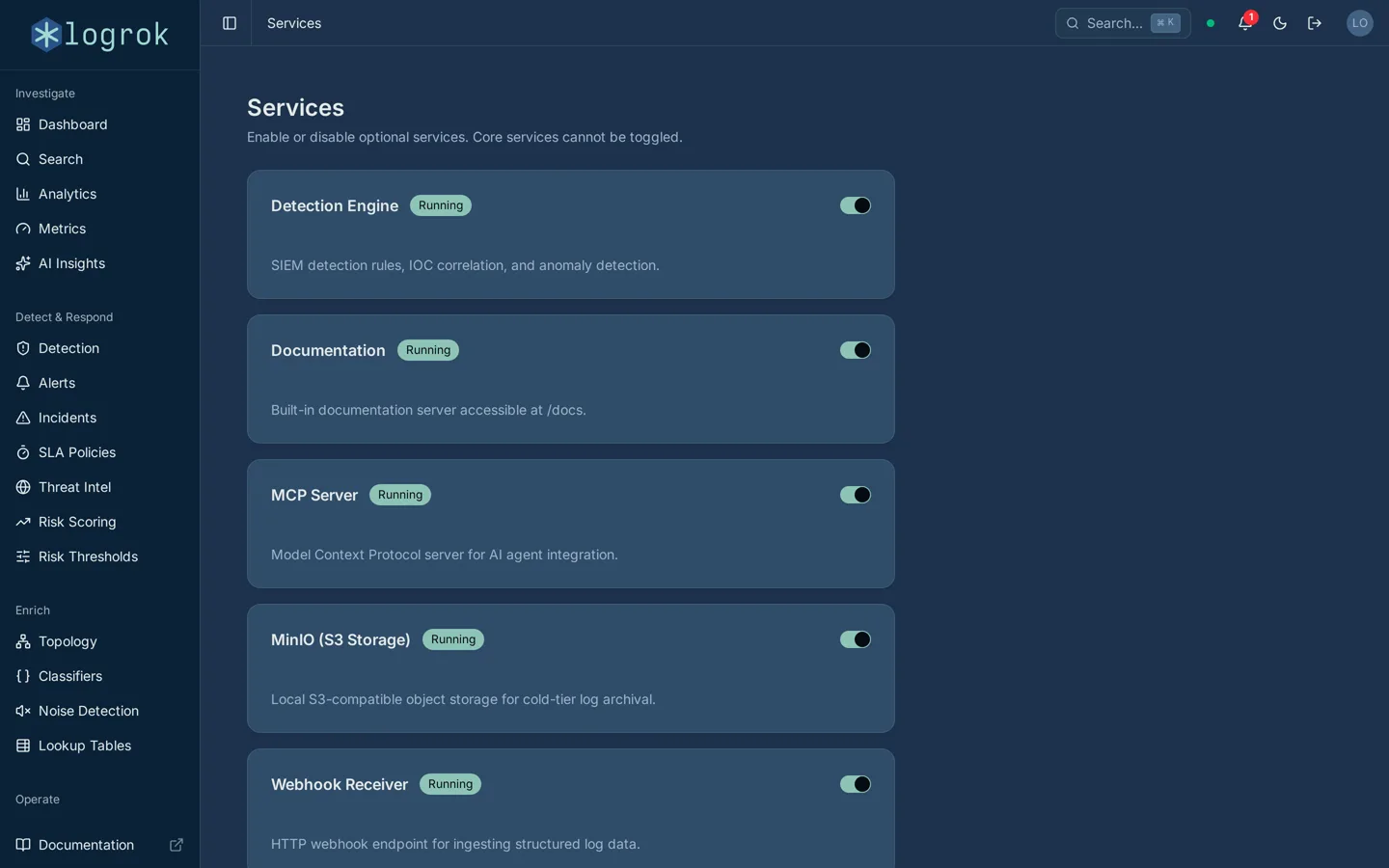
Exposes logrok operations to AI agents and workflow tools over the Model Context Protocol.
AI features are off by default and use the provider you configure. Point them at a self-hosted model (Ollama or an OpenAI-compatible gateway) and prompts stay on your network, including in air-gapped sites; hosted providers send data out of it. Detection rules, risk scoring, and threat-intelligence matching need no AI provider.
Architecture
REST API, web UI, and an AI agent interface. Pipelines, search, alerts, and automation.
High-performance log collector with config agents. Zero-touch pipeline deployment.
SQL analytics engine, a config store with row-level security, and SSO.
The collection layer
All of this ends in detection, not a database — but only once the logs arrive. LUnA, the logrok universal agent, is the front door to the ingest plane: a single static binary for Windows, Linux, and macOS that forwards RFC 5424 syslog or acknowledged OTLP/gRPC into the platform above.
Meet LUnA